
Running a Sex Offender Check in Beaver County
The official starting point is the Utah Sex and Kidnap Offender Registry, which the Utah Department of Corrections manages through the Sheriff Alerts platform. The portal requires acceptance of its use disclaimer before it opens the search. Choose Beaver County when the question is countywide. Use a city, ZIP code, or street address when the concern is tied to a smaller area. A name search works best when the spelling is known. The portal can show map or list results when that mode is available.
The registry answers a narrow question: whether Utah currently publishes a statutory registration profile that matches the search. It does not collect every arrest, court filing, or conviction in Beaver County. Someone reviewing a broader history should treat registry results as one official source among several. Recent registration changes may also require direct confirmation. For local registration procedures or an apparent compliance issue, use the Beaver County Sheriff's Office contact route or call 435-438-2862 before visiting the public-safety campus.
Beaver County Registry Disclaimer First
The acknowledgment screen is part of the search, not a formality to ignore. It states the lawful purpose and limits of the public data before the user reaches any Beaver County offender results. That order matters. A profile is released for safety and community notification under Utah law, while some information remains protected for law-enforcement or other statutory use. Public possession of a fact does not grant permission to threaten, shame, follow, or confront the listed person or anyone at the address.
Read the notice each time the portal presents it. Terms and controls can change. Then use the filters that fit the question and verify the selected profile instead of relying on a pin or result-card headline. An address result may cover a home, school, work, or other location only when Utah law makes that field public. The profile itself provides the context needed to understand what the location means.
Searching the Utah Sex and Kidnap Offender Registry
The Utah registry supports both identity and geographic routes. A Beaver County sex offender check can begin with a last name, or it can start from an address and radius. County and city filters reduce unrelated results. Exact options shown by the live portal may change, so use the labels on the current screen. Follow these steps to keep the search precise:
- Open the official Utah registry and accept the conditions of use after reading them.
- Enter a first and last name, or supply an address, city, ZIP code, and Beaver County filter.
- Choose the available radius, map, or list view that fits the location question.
- Open the matching profile and review the offense, status, address context, and agency information.
Do not assume that a broad map pin proves who lives at a precise spot. Open the result and compare the public identifiers. If a name is common, use the photograph and physical details rather than guessing. If no result appears, try both name and geographic routes. A blank result is not a certified statement that no criminal record exists.
| Field Label | Type | Required | Notes |
|---|---|---|---|
| Disclaimer acknowledgment | Button | Yes | Required before the search opens |
| First and Last Name | Text | No | Last name is the main identity field |
| Address | Text | No | Use a valid street or location |
| City, ZIP, County | Text / dropdown | No | Select Beaver County to narrow Utah results |
| Radius | Dropdown | Address dependent | Live options appear with geographic search |
| Map / List | View controls | No | Changes how geographic results appear |
Beaver County Registry Filters Compared
A county filter and an address-radius search answer different questions. Selecting Beaver County is useful for a broad scan of published profiles assigned to the county. It does not show distance from a specific place. An address-radius search is the better fit for awareness near a home, park, route, or other point. Its result depends on a valid location and the geographic data made public in each profile. Map and list views are two displays of that query, not separate databases.
Geographic gaps need care. A registrant may have moved, a profile may be in an update cycle, or a location field may not be public in the way a user expects. Search by name as a second route when an identity is known. Then call the agency contact shown on the profile if the address appears stale. The Beaver County Sheriff's Office can explain local reporting logistics, but staff, not a member of the public, should investigate an alleged failure to comply.
Note: A map marker is a search aid, not permission to enter private property or approach anyone shown in a Beaver County result.
What a Registry Profile Shows
A public Utah profile joins identity details with the registration basis and current status. Read all fields together. The photograph and physical description help separate people with similar names. Aliases can explain why one person appears under more than one spelling. Offense details identify the qualifying statute or jurisdiction, while dates can show when the conviction, release, or other reported event occurred. The agency and report-information route point to the proper office for follow-up.
Not every agency-held field belongs on the public profile. Utah can retain protected data for official use. Also, an address or other location field may appear only when state law authorizes public display. Do not infer misconduct from the absence of a field. The inventory below describes the types found in the official registry without reproducing any private person's values.
| Name & Aliases | Current name and reported alternate names |
|---|---|
| Photo & Description | Photograph plus public sex, race, height, weight, hair, eyes, and birth information |
| Registered Location | Address or other location context and its public status |
| Offense & Statute | Qualifying offense, jurisdiction, statute, and supplied dates |
| Marks | Public scars, marks, and tattoos when entered |
| Registration Status | Compliance, jurisdiction, verification details when supplied, and agency contact |
Beaver County Registry Across State Lines
The Utah registry is the right first source for a Beaver County address. A person may move, travel, or have a registration record held by another jurisdiction. The National Sex Offender Public Website, operated by the U.S. Department of Justice, adds a federated search across participating jurisdictions. It does not replace the Utah profile. Use it as a wider second pass when a location or identity crosses state lines.
The official NSOPW search capture assigned to Beaver County shows why a national layer can help:
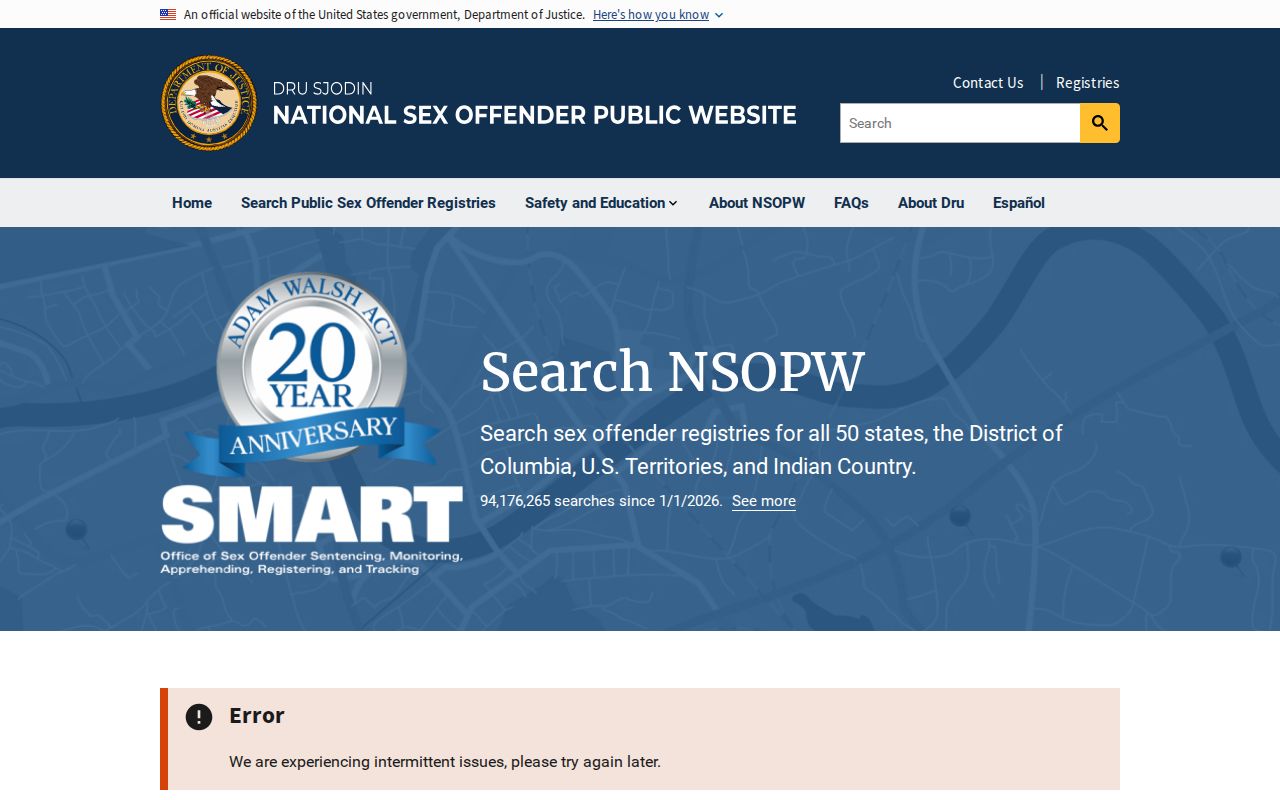
That national interface routes a search across public jurisdictional registries, while Utah remains the source for the complete state profile and its current status. Compare the identity fields before treating two results as the same person. When sources disagree, use the contact on the Utah profile or the relevant out-of-state agency rather than trying to resolve the conflict through direct contact with a registrant.
Registration Requirements and Levels in Utah
Utah does not place a simple federal Tier I, II, or III label on every public profile. State duties depend on Utah Code Title 77, Chapter 41 and the qualifying offense. Some registrants generally have duties for ten years after the end of sentence, custody, or supervision as calculated under current law. Other listed offenses carry lifetime registration. A specific statutory removal path may apply in limited cases, so neither duration nor removal should be guessed from the offense name alone.
The practical comparison is between Utah's statutory duration categories, not an invented tier. Check the precise offense under §§77-41-102 and 77-41-105. The registry profile and agency record supply the relevant classification and status.
| Utah Category | General Duration | Public Visibility |
|---|---|---|
| Statutory ten-year category | Commonly ten years after sentence, custody, or supervision ends, under current calculation rules | Public information appears as Utah law allows |
| Lifetime category | Life for offenses named by statute, unless a specific removal route applies | Public information appears as Utah law allows |
| Protected information | Held for authorized official use | Not made public merely because an agency has it |
Beaver County Registry Is Narrow
A registry result and a general criminal record serve different purposes. The Utah Sex and Kidnap Offender Registry covers people with qualifying registration duties and displays information selected by statute. It is not a list of every sex-related arrest, every dismissed case, or every criminal case in Beaver County. Likewise, a blank registry result does not prove that a person has no other court or arrest record. The official Beaver County portal routes residents to the county's separate public-safety services.
For a public case outcome, the court file is the better source. Utah State Courts Xchange carries public case numbers, charges, docket events, dispositions, and sentences when the record is available. A person reviewing their own fingerprint-supported Utah history uses BCI Right of Access, because BCI does not offer an unrestricted public name search. An underlying Beaver County law-enforcement record instead goes through Sheriff's Records. Keeping the source tied to the question prevents a registry profile from being stretched beyond what it establishes.
Outdated Beaver County Registry Addresses
An address that looks old should be reported, not investigated by the searcher. First reopen the full profile and check the status, agency, and available verification details. Confirm that the result is tied to the correct person and that the map did not place a broad location in a misleading way. Save the public profile URL or note the record details needed for an accurate report. Do not publish an accusation based on a map pin.
Contact the supervising registry or law-enforcement office shown on the profile. For Beaver County registration logistics, call the Sheriff's Office at 435-438-2862. The official sources reviewed do not publish specific local registration appointment hours or fees, so call before appearing. If there is an immediate threat, use 911. Agency staff can check non-public reporting data and decide whether any compliance step is due.
Note: Registry staff can verify a reporting issue with records that are not available in the Beaver County public search.
Lawful Use and Community Notification
Registry access supports personal, family, and neighborhood awareness. It can help residents understand published registration information and plan lawful safety steps. It does not authorize confrontation, public punishment, or interference with a household. Details should be checked against the full official profile because copied lists, social posts, and old screenshots can lose status updates and agency context.
Utah law places the limit in clear terms. Report suspected noncompliance through the registry contact or law enforcement. Let trained staff compare the public concern with the official file.
Registry misuse is a crime: Utah Code §77-41-110 restricts use of registry information to harass, threaten, intimidate, or commit another crime. Use Beaver County registry records only for lawful safety and community-notification purposes.